
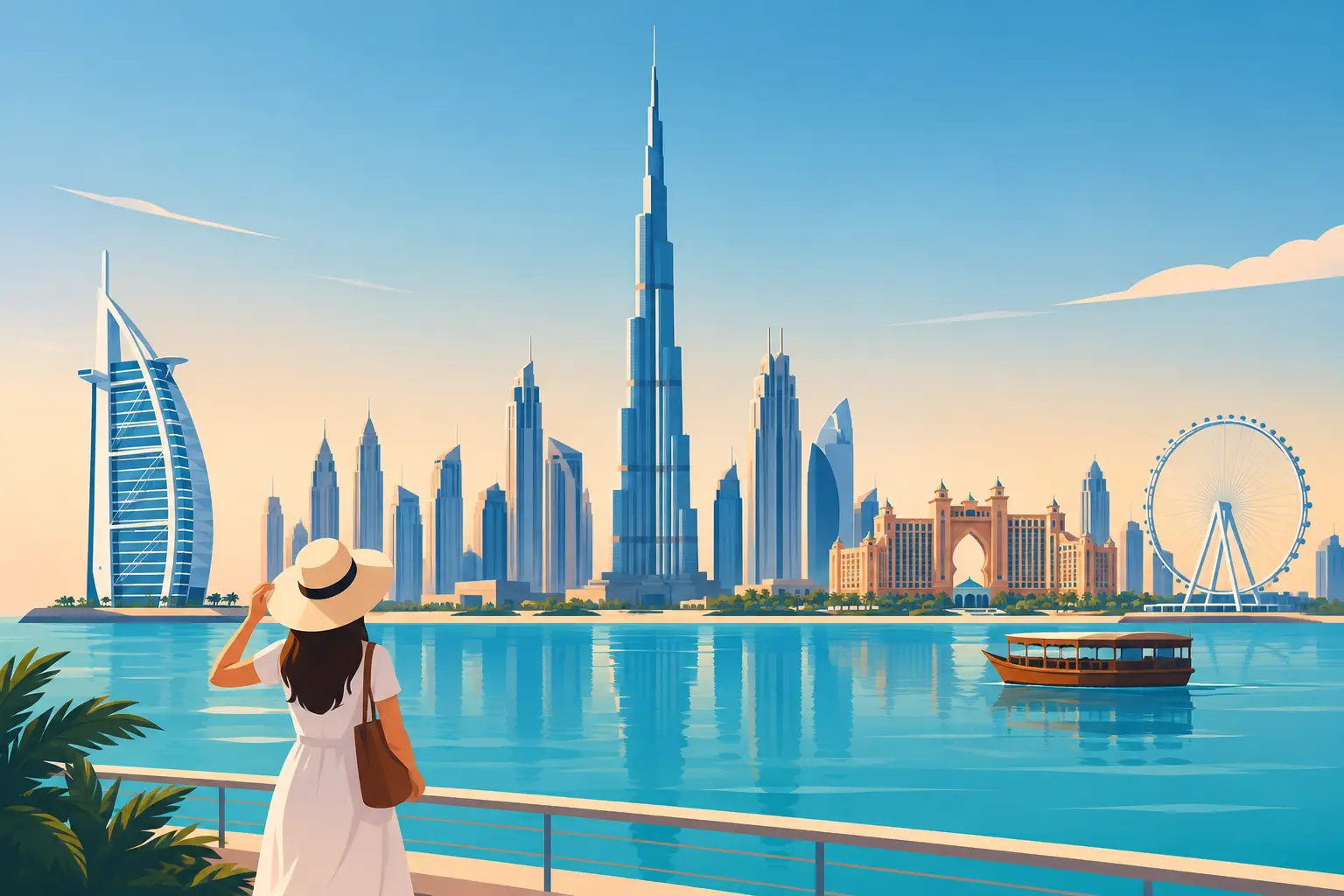
Dubai rewards travellers who plan by neighbourhood, not by a long checklist. The city’s most famous sights can look close together on a map, yet heat, traffic, attraction entry times and waterfront distances soon change the plan. These Dubai landmarks are worth seeing, but the best experience comes from pairing each one with the right time of day, comfortable transport and enough room to enjoy the view rather than rush through it.
Dubai landmarks that define the modern city
Burj Khalifa and Downtown Dubai
Burj Khalifa is the landmark most visitors picture first, and it earns its place. Rising above Downtown Dubai, it is particularly striking from the lake promenade, where the full scale of the tower is easier to appreciate than from directly underneath it. Book an observation deck slot in advance if the view is a priority, especially around sunset and on weekends.
There is a trade-off with peak sunset times: the colours are beautiful, but queues and crowds are at their highest. A daytime visit is often easier for families with younger children, while an evening visit lets couples enjoy the city lights and the Dubai Fountain performances outside. Allow time for security, lifts and photographs rather than treating it as a quick stop.
Downtown is also a practical starting point for a private city tour. Hotel pickup removes the need to work out taxis between districts, and a driver can wait nearby while you visit the tower, shop, eat or take in the fountain show.
Dubai Frame
Dubai Frame is one of the city’s clearest visual stories. From its elevated glass bridge, one side looks towards older neighbourhoods and Dubai Creek, while the other faces the high-rises that represent the city’s rapid growth. It is an excellent choice for first-time visitors who want a memorable view without committing several hours to a large complex.
Visit earlier in the day for a calmer experience and clearer photographs. The glass floor can be a thrill for some and a challenge for anyone uneasy with heights, so families should prepare children before stepping onto it. Zabeel Park is nearby, making this a comfortable stop in a well-paced sightseeing itinerary.
Museum of the Future
The Museum of the Future is impossible to miss on Sheikh Zayed Road. Its silver oval shape, patterned with Arabic calligraphy, has quickly become one of the most photographed buildings in Dubai. Even travellers who do not enter should stop for photos from the surrounding plaza.
Inside, the experience is imaginative rather than a traditional museum visit. It suits older children, teenagers and adults who enjoy technology, design and big ideas. Entry slots can sell out, so it is better to build a confirmed ticket time into your day than arrive expecting availability.
Burj Al Arab and Jumeirah Beach
The sail-shaped Burj Al Arab remains one of Dubai’s most recognisable sights. You do not need to stay there to enjoy the view. Public beach areas around Umm Suqeim offer excellent photo angles, especially in the softer light of late afternoon.
This stop works well with a drive along Jumeirah Beach Road, where the city feels more relaxed than Downtown. It can be combined with Madinat Jumeirah, whose waterways, restaurants and views of Burj Al Arab create a lovely setting for a slow evening meal. For couples, this is one of the more romantic parts of a city sightseeing day; for families, it offers space to walk and plenty of dining choice.
Historic Dubai landmarks around the Creek
Al Fahidi Historical Neighbourhood
Dubai is not only towers, malls and supercars. Al Fahidi Historical Neighbourhood gives visitors a different perspective, with narrow lanes, wind towers and restored courtyard houses that reflect life before the skyscrapers. It is a valuable contrast to the modern skyline and a good place to visit in the morning, before the strongest heat arrives.
Wear comfortable shoes, as the appeal is in wandering rather than ticking off one headline attraction. Small museums, galleries and cafés are tucked into the area, and the shaded passages make it manageable for families. A licensed guide can add real value here by explaining the architecture, trade history and traditions that are easy to miss when exploring alone.
Dubai Creek and an abra crossing
A short wooden abra ride across Dubai Creek is one of the simplest and most authentic experiences in the city. The crossing is brief, but it connects Bur Dubai with Deira and reveals the working waterway that helped make Dubai a trading hub. Traditional boats, dhows and the surrounding markets offer a scene that feels far removed from the polished towers of Downtown.
The Gold Souk and Spice Souk are nearby, and browsing them is often more enjoyable when you allow time to look rather than shop with a fixed target. Prices vary, and friendly bargaining is expected in many stalls. Keep valuables secure in busy areas, carry water and let your driver know a suitable collection point before entering the souks, as the lanes are not designed for vehicle access.
Al Seef
Al Seef sits beside the Creek and blends heritage-inspired architecture with modern cafés, shops and waterfront dining. It is easier to navigate than the souks and works particularly well as a late-afternoon stop after Al Fahidi. The promenade is buggy-friendly in most areas, which makes it useful for families who want an unhurried evening by the water.
Palm Jumeirah, Dubai Marina and the coast
Atlantis, The Palm
Atlantis, The Palm marks the outer crescent of Palm Jumeirah and is a favourite for photographs, family attractions and resort dining. The drive onto the Palm is part of the experience, with views across villas, beaches and the Arabian Gulf. It is best combined with other coastal sights rather than treated as a separate cross-city journey.
If your holiday includes a waterpark visit, aquarium experience or a meal at the resort, reserve most of the day. If you only want photographs, a private tour can make the stop short and efficient before continuing to Dubai Marina or Bluewaters Island.
Dubai Marina and Ain Dubai views
Dubai Marina offers a very different mood: towers rising around a yacht-filled waterfront, busy promenades and plenty of restaurants. It becomes especially lively after sunset, when the heat eases and the buildings reflect on the water. A dinner cruise is a comfortable way to see the Marina from a new angle, particularly for couples celebrating a special occasion or families who prefer sightseeing without more walking.
From the Marina and nearby Bluewaters, you can also see Ain Dubai, the giant observation wheel. Its operating schedule may change, but the structure itself remains a dramatic part of the coastline. Give yourself extra travel time in this district during evening peak hours, as roads can be busy around dining times.
How to see Dubai landmarks without losing the day
Trying to cover every major sight in one day usually means seeing very little properly. A better approach is to choose one route: Downtown and the Museum of the Future; Old Dubai and the Creek; or Palm Jumeirah, Jumeirah and Dubai Marina. Visitors with two or three days can comfortably mix these areas while leaving time for a desert safari, shopping or a relaxed beach afternoon.
Private transport is particularly useful for groups, families with car seats or travellers visiting during the warmer months. Air-conditioned vehicles, hotel collection and an experienced driver make the gaps between landmarks easier, while you can tailor the pace around meal times, prayer times, children’s naps or a pre-booked attraction ticket. The 7 Tours can arrange private city sightseeing with pickup, so your itinerary is built around the places you genuinely want to see.
Dress respectfully when visiting heritage districts and religious sites, carry sunglasses and water, and keep a light layer for aggressively air-conditioned attractions. For the best photographs, early morning and the hour before sunset are usually kinder than midday. Just remember that popular locations are busiest at precisely those times, so a little flexibility goes a long way.
Leave one evening free for the view that suits your holiday best: fountain lights beneath Burj Khalifa, a Marina dinner cruise, or a sunset over the desert after a day in the city. Dubai is at its best when the journey between its landmarks feels as easy as the landmarks themselves.